


Travertine has been used in architecture for more than two thousand years and remains one of the most specified natural stones for luxury residential, hospitality, and commercial interiors. Unlike marble or granite, travertine contains naturally formed pores created by mineral-rich groundwater during deposition. These pores, together with the cutting direction, define the appearance and functional performance of the finished product.
Today, architects specify travertine in a wide range of applications, including:
- Natural Travertine Big Slabs
- Beige Travertine Filled & Unfilled Stone Slabs
- Silver Grey Travertine Decorative Wall & Floor Tiles
- Bathroom Vanity Tops
- Kitchen Countertops
- Waterfall Island Tops
- Feature Wall Panels
- Reception Desk Countertops
- Hotel Bathroom Vanity Tops
- Outdoor Wall Cladding
Proper material selection begins with understanding the difference between Vein Cut and Cross Cut.
Vein Cut vs. Cross Cut: How the Quarry Block Is Cut
Travertine is quarried in large blocks. The orientation of the saw blade determines the final appearance of the stone.

Vein Cut Travertine
Vein cut slabs are sawn parallel to the natural bedding plane.
This exposes long linear mineral bands that create a contemporary appearance with continuous movement.
Typical applications include:
- Modern feature walls
- Waterfall kitchen islands
- Commercial reception desks
- Large-format wall panels
- Minimalist interior spaces
Characteristics:
- Linear vein patterns
- Directional texture
- Modern architectural appearance
- Excellent for book matching
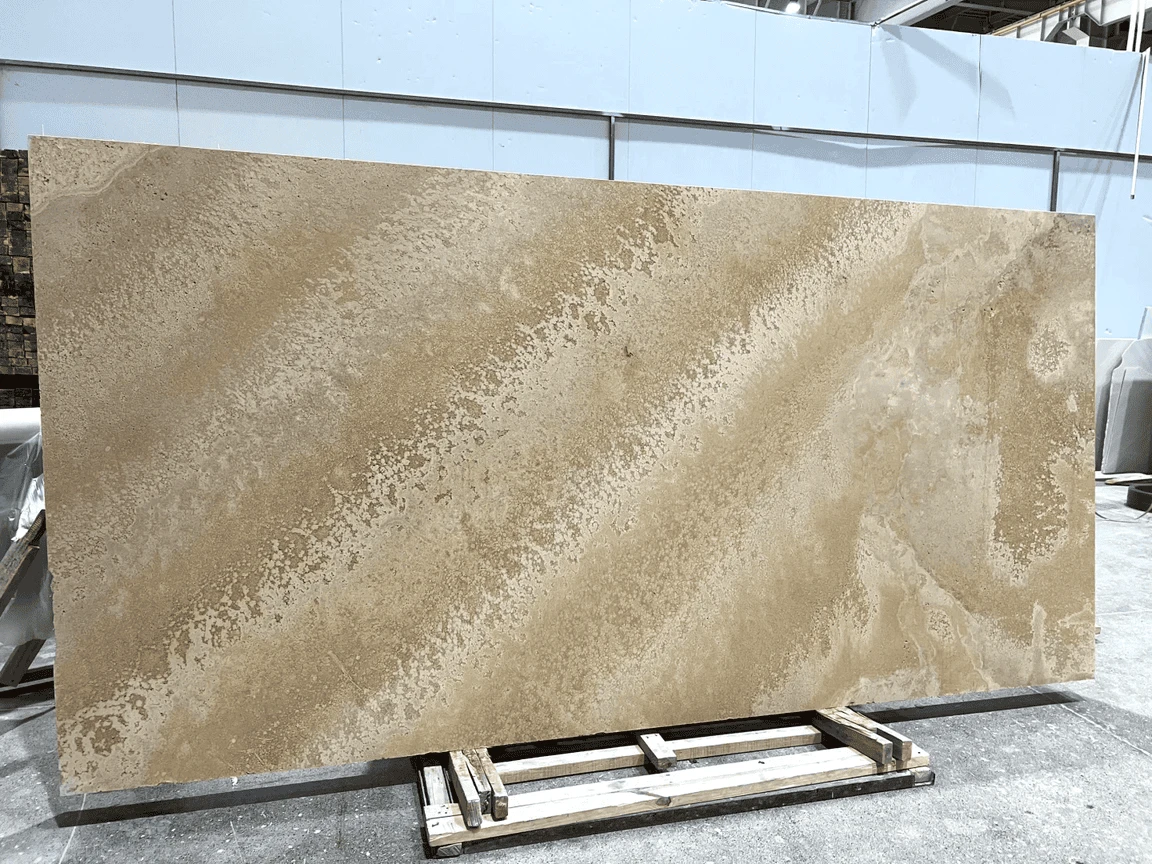
Cross Cut Travertine
Cross cut slabs are cut perpendicular to the bedding plane. Instead of continuous veins, the surface reveals cloud-like patterns with scattered natural pores. Common applications include:
- Indoor flooring
- Bathroom walls
- Spa projects
- Wabi-Sabi interiors
- Residential living spaces
Characteristics:
- Organic texture
- Random movement
- Softer visual appearance
- Traditional Mediterranean style
Comparison Table
| Item | Vein Cut | Cross Cut |
|---|---|---|
| Cutting Direction | Parallel to bedding | Perpendicular to bedding |
| Appearance | Linear veins | Cloud-like texture |
| Design Style | Modern | Natural |
| Book-Matching | Excellent | Moderate |
| Wall Panels | Excellent | Good |
| Floor Tiles | Good | Excellent |
| Reception Desk | Excellent | Good |
Filled vs. Unfilled Travertine
Natural travertine contains pores of different sizes. These pores may be left open or filled depending on the application.
Filled vs. Unfilled Travertine
Filled Travertine
Filled travertine uses cementitious or resin-based fillers to close surface voids before honing or polishing.
Advantages:
- Smoother surface
- Easier cleaning
- Better stain resistance
- Improved walking comfort
- Suitable for hospitality interiors
Typical products include:
- Filled Travertine Smooth Surface Feature Wall Panel
- Factory Custom Cut Filled Resin Grout Travertine Slab
- Honed Matte Beige Travertine Floor Tile
- Polished Silver Grey Travertine Wall Slab
Unfilled Travertine
Unfilled travertine preserves the natural pore structure.
Advantages:
- Authentic texture
- Better slip resistance
- Natural appearance
- Preferred for outdoor applications
- Compatible with Wabi-Sabi interiors
Typical products include:
- Unfilled Travertine Wall Cladding
- Raw Porous Travertine Stone Panel
- Large Format Porous Travertine Slab

Filled vs. Unfilled Comparison
| Property | Filled | Unfilled |
| Surface Texture | Smooth | Textured |
| Cleaning | Easy | Moderate |
| Slip Resistance | Moderate | Higher |
| Outdoor Use | Limited | Excellent |
| Luxury Hotel Interiors | Excellent | Good |
| Pool Deck | Moderate | Excellent |

Resin Filling vs. Cement Grouting
Modern hospitality projects generally use two filling methods.
Resin Filling
Characteristics:
- Better color consistency
- High bonding strength
- Reduced water penetration
- Stable polishing quality
- Recommended for:
- Vanity tops
- Kitchen countertops
- Reception desks
- Interior wall panels
Cement Grouting
Characteristics:
- Traditional solution
- Natural appearance
- Economical
- Easy maintenance
- Recommended for:
- Indoor flooring
- Large commercial paving
- Residential interiors
Unsure which travertine finish fits your project?
Request Filled vs. Unfilled Samples
Which Travertine Finish Is Better for Outdoor Swimming Pools?
Swimming pool environments combine moisture, ultraviolet exposure, temperature variation, and barefoot traffic.
Selecting the correct surface finish is more important than selecting color alone.
Recommended Surface Finishes
| Finish | Slip Resistance | Pool Suitability |
| Honed | Good | Excellent |
| Brushed | Excellent | Excellent |
| Tumbled | Excellent | Excellent |
| Polished | Low | Not Recommended |
Why Unfilled Travertine Performs Well Outdoors
The natural pores create additional surface friction.
Advantages include:
- Improved wet slip resistance
- Lower reflected heat
- Comfortable barefoot walking
- Natural drainage of surface water
- Reduced glare
This makes unfilled travertine particularly suitable for:
- Swimming pool decks
- Garden pathways
- Courtyards
- Resort landscapes

Travertine Countertops and Vanity Tops
Travertine is increasingly used for custom fabricated products.
Popular applications include:
- Bathroom Vanity Countertops
- Kitchen Countertops
- Waterfall Islands
- Reception Desk Tops
- Dining Tables
- Window Sills
Common fabrication options:
- Single sink cutouts
- Double sink cutouts
- Faucet hole drilling
- Curved edge processing
- Waterfall edge fabrication
- CNC precision cutting
Available thicknesses:
| Thickness | Typical Application |
| 20 mm | Vanity tops |
| 30 mm | Reception desks |
| 40 mm Laminated | Waterfall islands |
Book-Matched Travertine for Feature Walls
Large-format travertine slabs are frequently installed using book-matching techniques.
Book matching creates symmetrical patterns across adjacent slabs, particularly with Vein Cut material.
Applications include:
- Luxury hotel lobbies
- Villa entrance walls
- Commercial reception areas
- Feature fireplaces
- Executive meeting rooms
Dry-lay inspection before fabrication allows designers to confirm vein continuity before cutting.

Travertine requires export packaging designed to protect both the stone and the finished surface.
Packaging methods depend on product type.
Finished Small Products
Typical packaging:
- Individual cartons
- Foam protection
- Corner guards
- Barcode labeling
Suitable for:
- Vanity tops
- Retail products
- Decorative panels
Large Slabs and Commercial Orders
Export packaging includes:
- Heat-treated wooden crates
- Internal timber blocking
- Waterproof wrapping
- Foam separators
- Reinforced pallet bases
For oversized slabs, additional cross-bracing is installed to reduce deformation during long-distance ocean transport.

Packaging Comparison
| Product | Packaging |
| Retail Vanity Top | Individual Carton |
| Countertop | Reinforced Wooden Crate |
| Large Slab | Export Wooden Crate |
| Feature Wall Panels | Heavy-duty Crate |
Quality Control During Production
Before shipment, travertine products undergo multiple inspections.
Production control includes:
- Quarry block grading
- Color consistency selection
- Pore evaluation
- Thickness calibration
- CNC dimensional inspection
- Surface finish inspection
- Trial dry-lay
- Export packaging inspection
Typical fabrication tolerance:
Thickness/ Length/ Sink Cutout: ±5mm: ±1 mm
Planning a hotel or villa project with travertine?
Get a Factory Fabrication Proposal
Typical Applications
Travertine products are widely specified for:
- Luxury villas
- Boutique hotels
- Resort developments
- Apartment bathrooms
- Commercial reception areas
- Spa centers
- Restaurants
- Retail interiors


Popular fabricated products include:
- Bathroom vanity tops
- Kitchen countertops
- Waterfall islands
- Feature walls
- Floor tiles
- Wall cladding
- Reception counters
- Window surrounds
FAQ
Which is better for a modern interior: Vein Cut or Cross Cut travertine?
Vein Cut travertine creates continuous linear patterns that complement contemporary architecture and book-matched feature walls. Cross Cut travertine provides softer, cloud-like textures commonly used in residential flooring, spa facilities, and Mediterranean-style interiors.
Should travertine be filled or unfilled for outdoor pool areas?
Unfilled travertine generally offers higher slip resistance because the natural pores improve surface traction. Honed, brushed, or tumbled finishes are commonly specified for swimming pool surrounds and outdoor pedestrian areas.
How are large travertine slabs protected during international shipping?
Large slabs are packed in seaworthy wooden crates with foam separation, waterproof wrapping, internal timber blocking, and reinforced cross-bracing for oversized crates. This packaging reduces movement, edge impact, and deformation during long-distance ocean transportation.
Conclusion
Although Vein Cut and Cross Cut travertine originate from the same quarry block, they provide distinctly different architectural effects. Combined with the appropriate choice of filled or unfilled pores, surface finish, and fabrication method, travertine can be adapted for flooring, wall cladding, countertops, vanity tops, reception desks, and large hospitality projects.
For architects, developers, and distributors sourcing premium travertine products, selecting the correct cut, finish, and fabrication solution at the beginning of the project helps improve installation efficiency, appearance consistency, and long-term performance.
Explore our Travertine Product Catalog for available slab collections, custom fabrication services, and project support for residential, hospitality, and commercial developments.
