1. Stone Edge Profiles: 10 Common Countertop Edge Options
A countertop edge profile is the shaped and finished cross-section along an exposed stone edge. Profile selection should be based on the finished thickness, cabinet design, countertop use, fabrication equipment and the number of repeated units.
1.1 Common Natural Stone Edge Profiles
| Edge Profile | Cross-Section Description | Visual Character | Typical Applications | Fabrication Complexity |
|---|---|---|---|---|
| Straight Edge | Square vertical face with a defined corner | Clean, geometric | Contemporary kitchens, commercial counters | Low |
| Eased Edge | Straight face with slightly softened top and bottom corners | Minimal and practical | Apartments, hotels, residential kitchens | Low |
| Pencil Edge | Small rounded transition along the exposed corner | Soft, understated | Bathroom vanity tops, kitchen counters | Low–Medium |
| Beveled Edge | Angled cut along the top corner | Defined linear detail | Contemporary and transitional interiors | Low–Medium |
| Double Bevel Edge | Two bevelled transitions forming a more detailed edge | Decorative geometric profile | Feature countertops and selected vanity tops | Medium |
| Bullnose Edge | Fully rounded exposed profile | Soft, continuous appearance | Traditional kitchens, family homes, vanity tops | Medium |
| Half Bullnose Edge | Rounded upper edge with a flatter lower face | Soft upper transition, defined underside | Kitchen countertops and bathroom vanities | Medium |
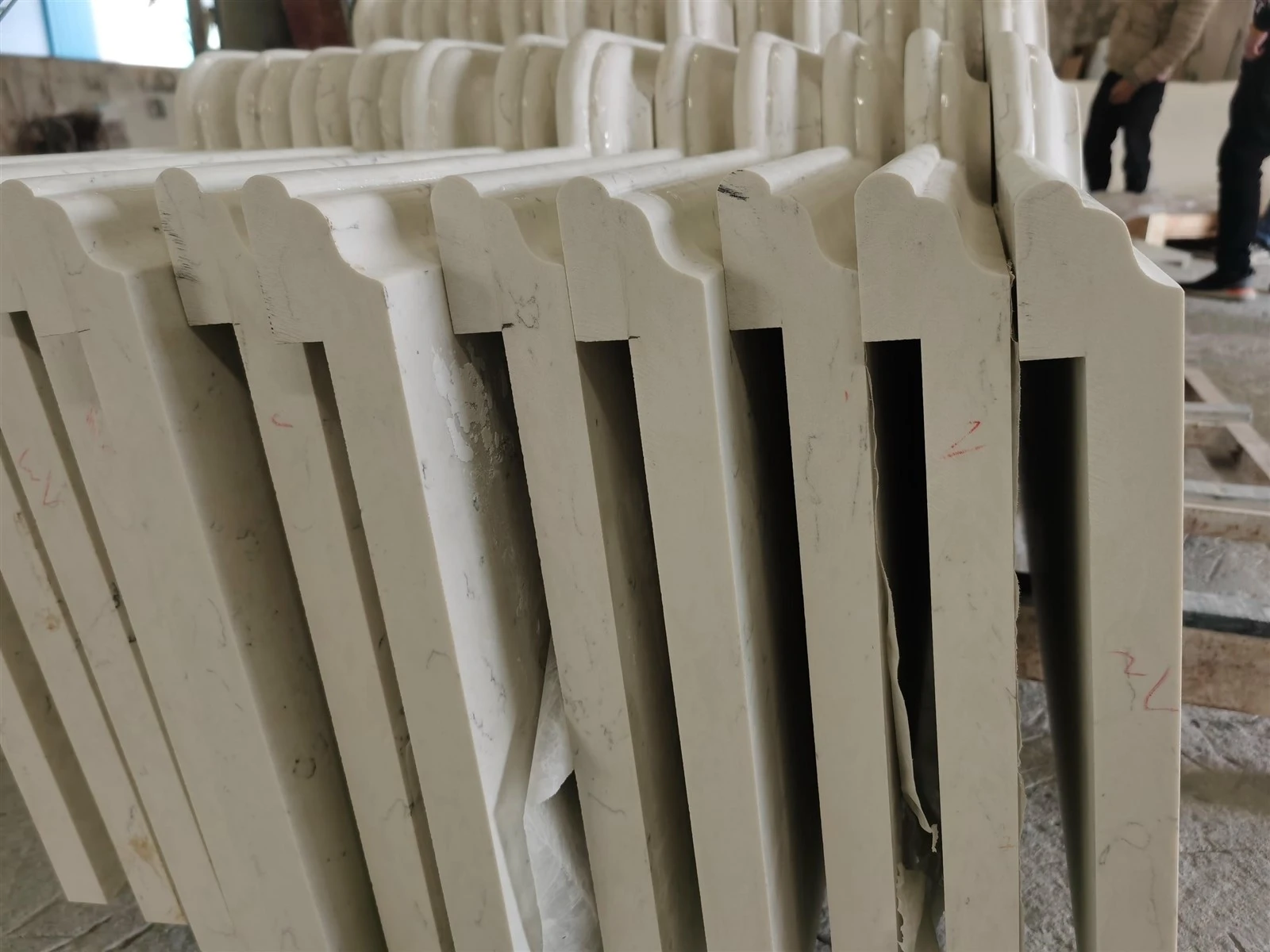
| Ogee Edge | S-shaped concave and convex decorative profile | Formal and ornamental | Traditional kitchens, luxury residential interiors | High |
| Dupont Edge | Decorative profile with a projecting upper detail and curved transition | Classic, prominent edge | Traditional stone countertops | High |
| Mitered Edge | Separate stone strips joined at an angle to create a thicker appearance | Thick, monolithic appearance | Waterfall islands, contemporary kitchens | High |
Fabrication complexity is a relative planning index, not a standardized industry rating. Actual processing depends on stone hardness, mineral structure, thickness, edge dimensions, equipment and finish requirements.
1.2 Straight Edge vs. Eased Edge
These profiles are frequently specified for large countertop programs because they have simple geometry and can be repeated across multiple pieces.
A straight edge retains a sharper visual corner. An eased edge introduces a small radius or chamfer to reduce the sharpness of the exposed corner. The exact radius should be stated in the drawing rather than assumed from the profile name.
For large residential developments, eased edges are often a practical default because they combine a restrained appearance with relatively simple fabrication. A straight edge is suitable where the design requires a crisp perimeter, provided the exposed corners and installation conditions are properly addressed.
1.3 Bullnose vs. Half Bullnose
A bullnose edge has a continuous rounded profile across the exposed edge. A half bullnose rounds the upper portion while retaining a flatter lower face.
| Comparison | Full Bullnose | Half Bullnose |
|---|---|---|
| Upper transition | Fully rounded | Rounded |
| Lower transition | Rounded | Flat or minimally eased |
| Visual effect | Soft, continuous perimeter | Softer top with a more defined underside |
| Cleaning | No sharp upper corner | No sharp upper corner at the top |
| Fabrication | Requires consistent shaping and polishing | Requires shaping and polishing of the upper curve |
| Common use | Traditional kitchens, vanity tops | Residential kitchens, bathroom counters |
The choice is primarily visual and dimensional. Neither profile should be treated as a substitute for correct countertop support or protection against impact.
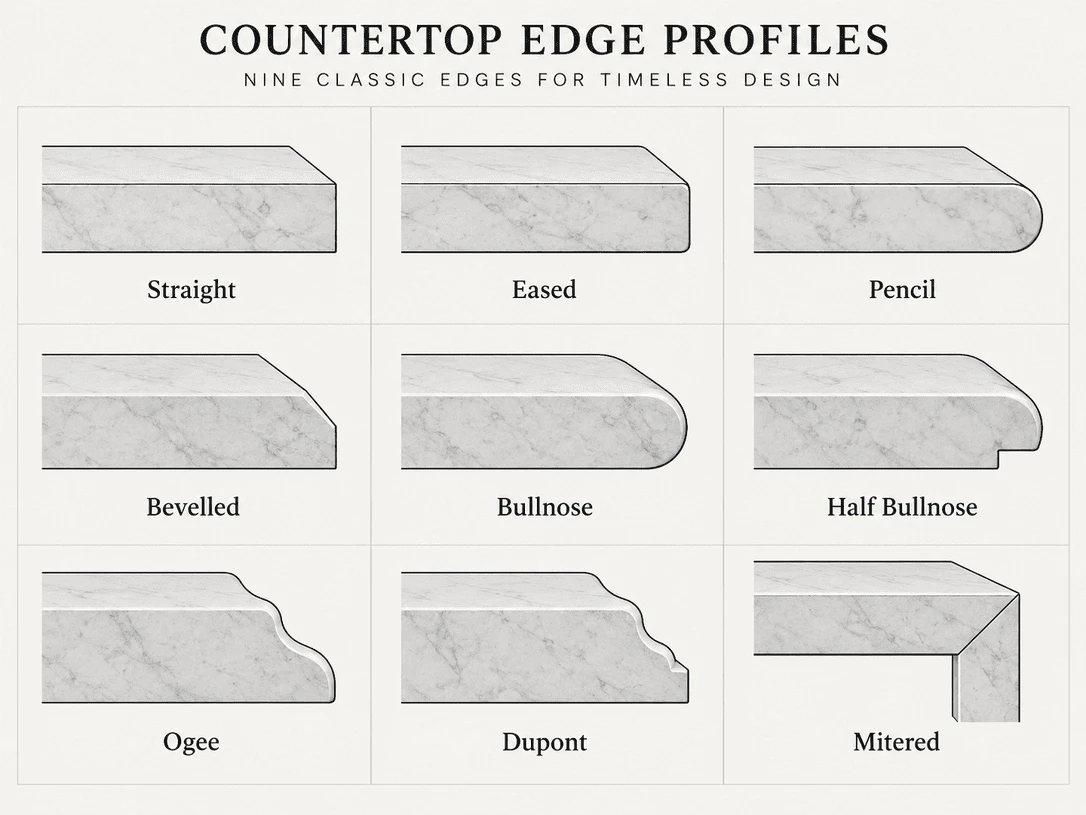
Natural stone countertop edge profiles comparison including eased, bullnose, ogee and mitered edges
2. Fabrication Difficulty and Relative Cost of Eased, Bullnose and Ogee Edges
Edge fabrication cost is influenced by the number of shaping and polishing operations, tool changes, operator time, stone characteristics and production quantity. A profile name alone is not enough to calculate a reliable quotation.
For procurement comparisons, the following index provides a relative planning reference. It is not a factory price list or a universal cost ratio.
2.1 Relative Fabrication Complexity Index
| Edge Profile | Relative Complexity Index | Main Processing Operations | Cost Drivers |
|---|---|---|---|
| Eased Edge | 1.0 | Straight cutting, corner easing, edge polishing | Edge length, corner radius, finish |
| Straight Edge | 1.0 | Straight cutting and edge finishing | Cutting accuracy, exposed edge finish |
| Pencil Edge | 1.2–1.4 | Small-radius shaping and polishing | Radius consistency, polishing access |
| Beveled Edge | 1.2–1.5 | Angle grinding and polishing | Bevel width, angle, finish |
| Half Bullnose | 1.4–1.8 | Curved shaping and edge polishing | Curve dimensions, stone hardness |
| Full Bullnose | 1.5–2.0 | Full-radius shaping and polishing | Radius, edge length, material structure |
| Double Bevel | 1.5–2.0 | Multiple bevel cuts and finishing | Number of transitions, dimensional control |
| Ogee Edge | 2.0–3.0 | Multi-stage profiling, grinding and polishing | Profile depth, tooling, manual finishing |
| Dupont Edge | 2.0–3.0 | Multi-stage decorative shaping and polishing | Projection, curve detail, corner finishing |
| Mitered Edge | 2.0–3.0 | Angled cutting, joint preparation, bonding and finishing | Joint accuracy, visible seam, reinforcement and pattern alignment |
Index 1.0 represents a basic straight or eased edge under the same material, thickness, finish and production conditions. The other figures are indicative complexity multipliers for preliminary comparison only. They are not verified price multipliers. Actual quotations require drawings and production details.
2.2 Why Ogee Edges Cost More Than Eased Edges
An eased edge generally requires a straightforward edge treatment and a consistent small corner transition. An ogee edge contains multiple curved and recessed sections, so the fabricator must control the profile geometry and maintain a consistent finish across the full exposed length.
The main cost factors are:
- Tooling and profile setup: More complex geometry may require dedicated profiling tools or additional machine setup.
- Grinding stages: Multiple transitions require more shaping and refinement.
- Polishing access: Recessed sections can be harder to finish consistently than a flat edge.
- Corner treatment: Internal and external corners require additional attention to maintain profile continuity.
- Material condition: Veins, fissures, mineral inclusions and resin-filled areas may affect the processing approach.
An ogee profile should be approved with a cross-section drawing or physical sample. A written description alone may not define the exact curve, projection or overall edge depth.
2.3 How Production Quantity Changes Unit Cost
For a single countertop, machine setup and manual finishing can account for a significant portion of the fabrication cost. In a repeated project, consistent dimensions and a standardized edge profile can reduce setup variation and simplify quality checks.
| Production Scenario | Cost-Control Priority | Recommended Approach |
|---|---|---|
| One custom kitchen | Design accuracy and visual finish | Approve a profile sample and full shop drawing |
| Several luxury apartments | Consistent appearance across units | Standardize the edge section and corner details |
| Large apartment development | Repeatability and production efficiency | Use a simple profile with consistent dimensions |
| Hotel guestroom vanity program | Uniformity and predictable maintenance | Specify one repeatable edge profile across room types |
| Commercial counters | Durability and ease of cleaning | Use a simple profile with controlled corner treatment |
For large projects, the total exposed edge length is an important quotation input. A countertop with many cut-outs, returns, short sections and external corners may require more edge processing than a larger but simpler rectangular worktop.
Comparing edge costs across multiple countertop units?
Request Custom Edge Fabrication Quote
3. How to Choose a Countertop Edge Profile by Interior Design Style
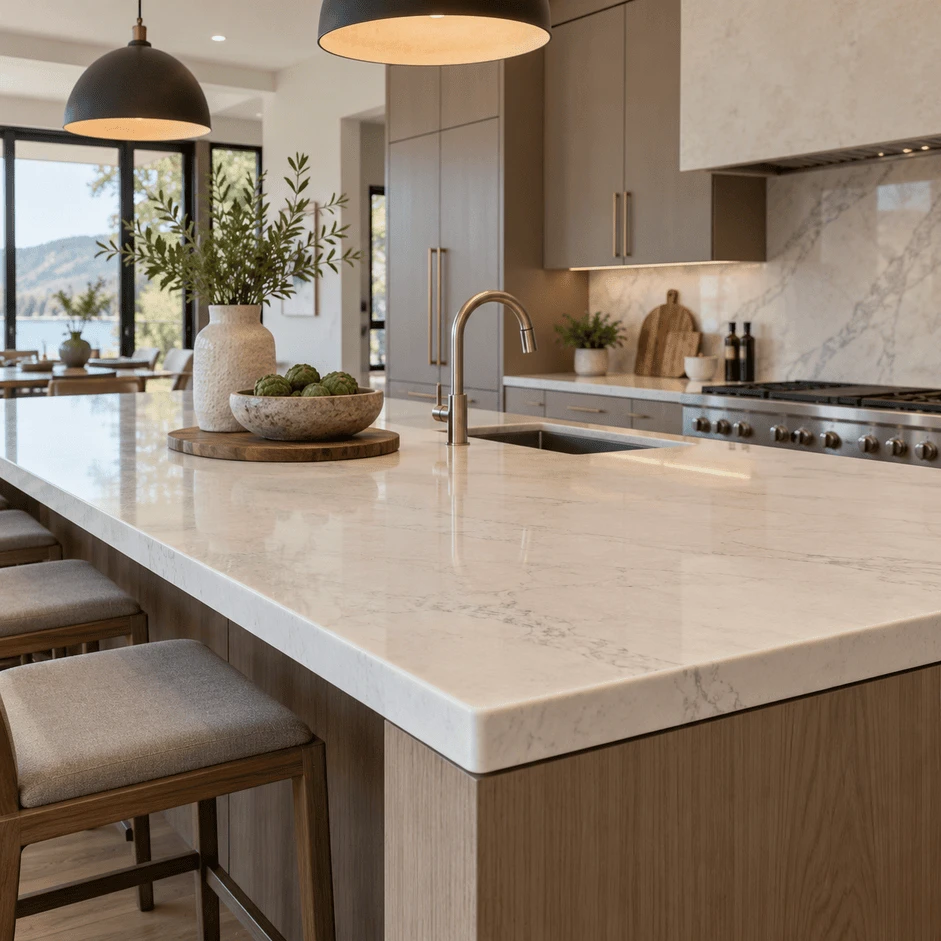
The edge should support the overall design rather than compete with the slab pattern, cabinet fronts or other architectural details. A strong marble vein pattern may already provide visual movement, while a quieter granite or quartzite surface can accommodate a more defined edge.
3.1 Contemporary and Minimalist Kitchens
Recommended profiles: Straight, Eased, Pencil and Mitered
Contemporary kitchens generally use simple cabinet fronts, integrated appliances and restrained material transitions. Straight and eased edges maintain a clean perimeter without adding a decorative element.
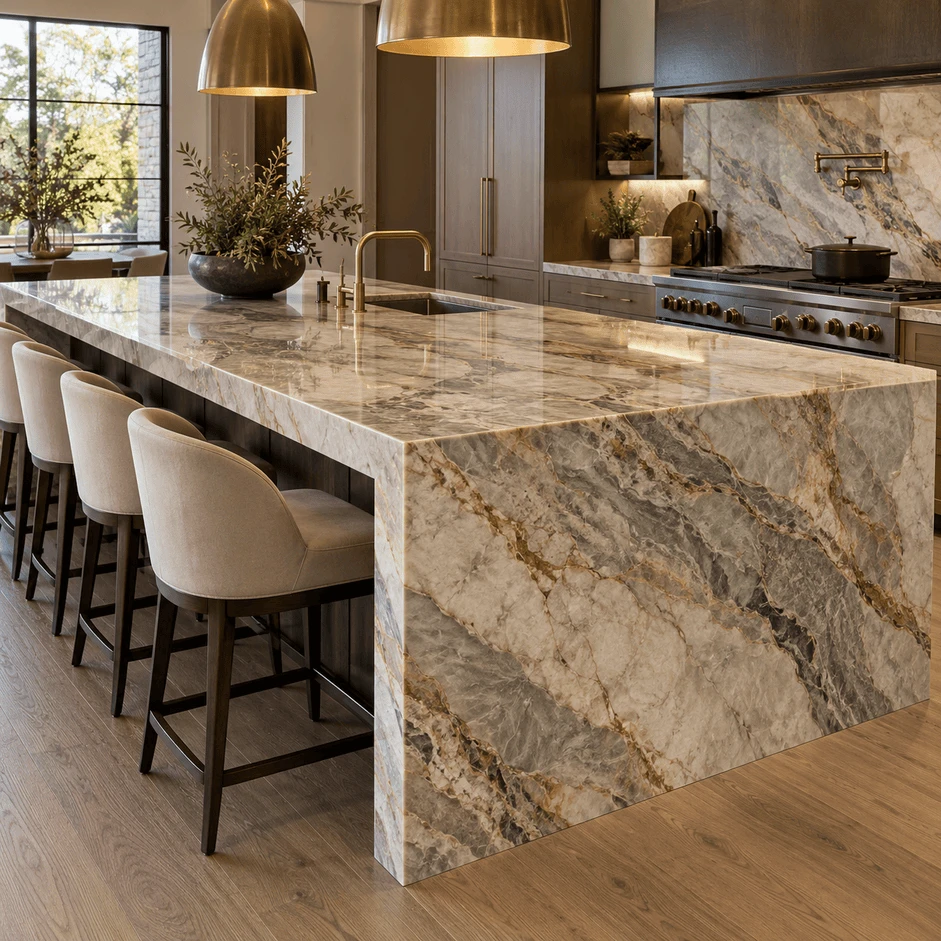
A mitered edge can create the appearance of a thicker countertop, particularly on islands and waterfall panels. It requires accurate angled cuts and a well-planned joint. The visible seam and vein direction should be reviewed before fabrication.
3.2 Traditional and Classic Kitchens
Recommended profiles: Bullnose, Half Bullnose, Ogee and Dupont
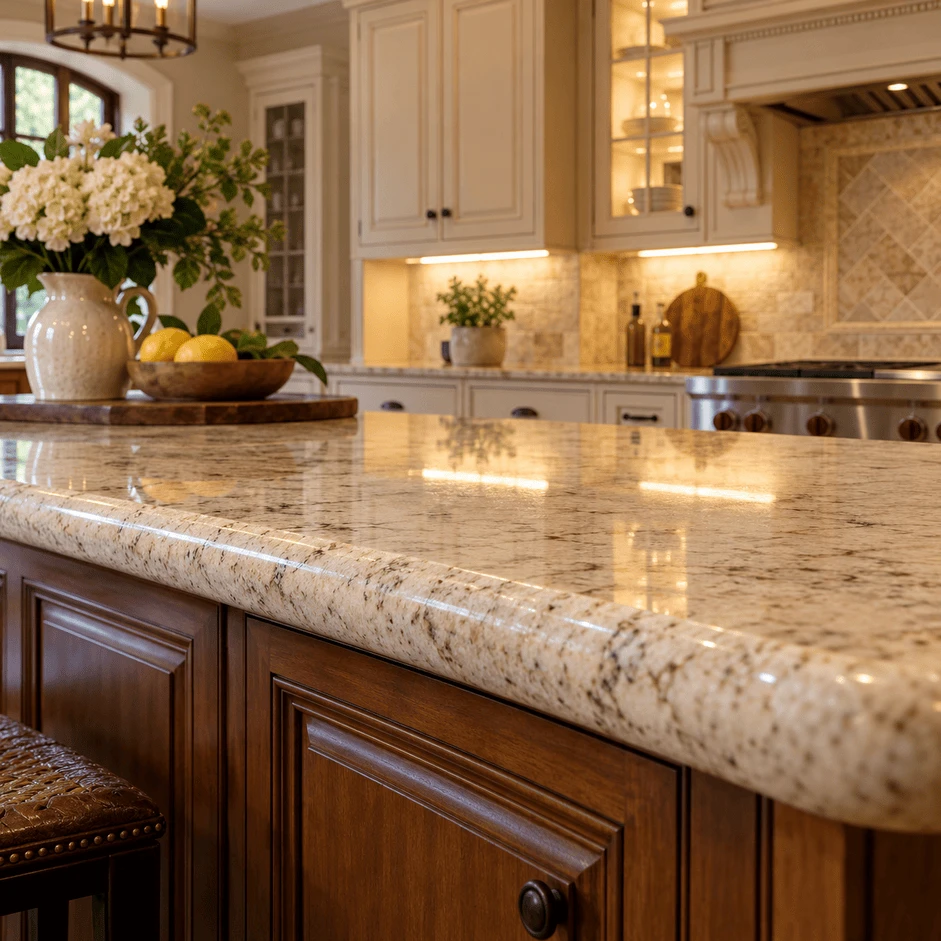
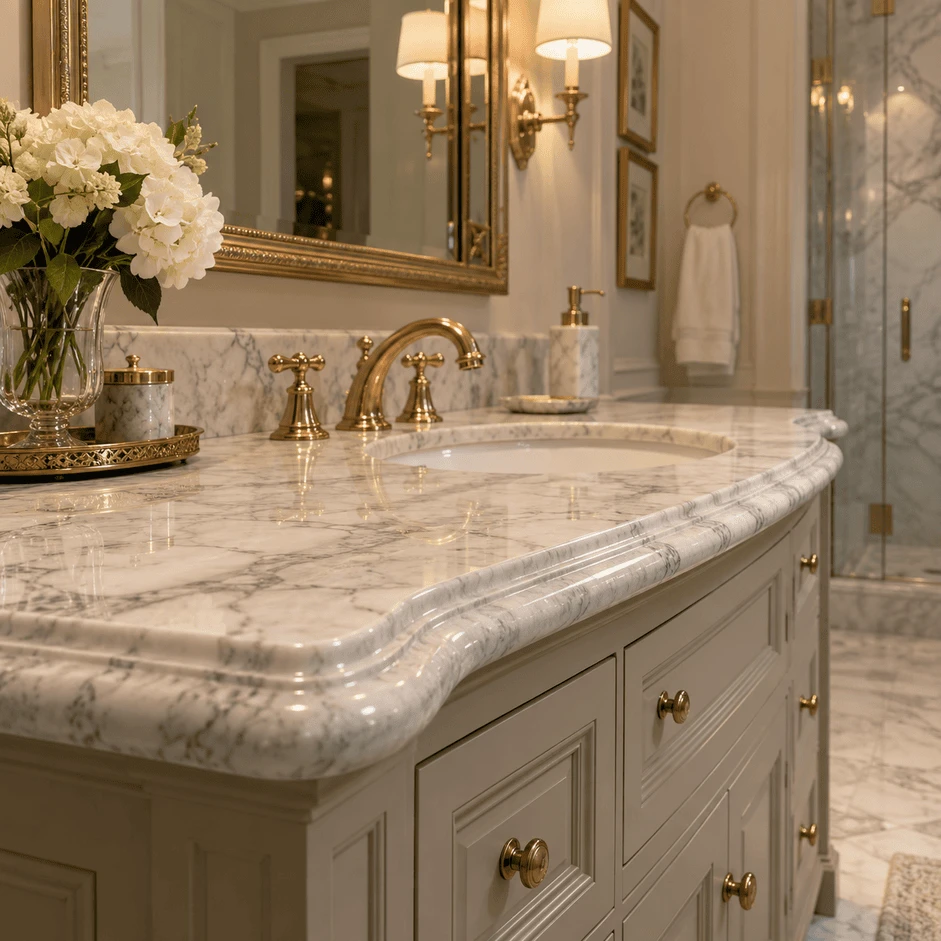
Traditional interiors often use framed cabinetry, decorative mouldings and more detailed architectural elements. Rounded and ornamental profiles can coordinate with these features.
Ogee and Dupont profiles are more visually prominent. They are best specified where the countertop has enough exposed edge length to show the profile clearly. On narrow vanity tops or small countertop sections, a complex edge may have limited visual impact while retaining its additional fabrication cost.
3.3 Transitional and Luxury Residential Interiors
Recommended profiles: Eased, Beveled, Half Bullnose and selected Ogee
Transitional designs combine simple cabinet forms with selected decorative details. A bevelled edge can introduce a defined line without the visual weight of a full ornamental profile.
For luxury marble islands, the slab pattern should remain the primary visual feature. A simple eased edge often allows strong veining to remain visible without adding another competing detail.
3.4 Commercial Kitchens, Hotels and Apartment Projects
Recommended profiles: Eased, Straight and Pencil
For repeated installations, procurement teams should prioritize:
- Repeatable profile dimensions
- Consistent edge polishing
- Simple cleaning requirements
- Limited tooling changes
- Easy inspection across production batches
- Compatibility with the specified countertop thickness
A simple edge is usually easier to standardize across multiple units. It also reduces the number of profile-specific details that need to be checked during production and installation.
4. 2cm vs. 3cm Countertop Edge Profiles: Thickness and Construction
Nominal slab thickness affects the visible edge proportion, profile dimensions, weight and support requirements. A 20 mm slab and a 30 mm slab do not automatically use the same edge geometry.
The finished countertop thickness must be specified separately from the visual edge profile. A thick-looking edge can be produced using a mitered or laminated build-up, but the construction method should be clearly identified in the shop drawing.
4.1 Edge Options for 20 mm and 30 mm Stone
| Specification | 20 mm Stone | 30 mm Stone |
|---|---|---|
| Visual proportion | Slim, contemporary | More substantial |
| Eased edge | Suitable | Suitable |
| Straight edge | Suitable | Suitable |
| Pencil edge | Suitable where the radius fits the section | Suitable |
| Beveled edge | Bevel width must fit the available thickness | More room for a larger bevel |
| Bullnose | Profile size is limited by the section | Allows a larger rounded section |
| Ogee | Requires a compact profile design | Allows more profile depth |
| Mitered build-up | Can create a thicker visual edge | Can create a larger built-up appearance |
| Weight | Lower than an equivalent 30 mm component of the same material | Higher than an equivalent 20 mm component |
These are general fabrication considerations, not universal profile compatibility rules. Final feasibility depends on the actual stone, edge section, cut-outs, support conditions and fabricator's equipment.
4.2 Mitered Edge vs. Eased Edge Countertop
A mitered edge and an eased edge solve different design requirements.
| Factor | Mitered Edge | Eased Edge |
|---|---|---|
| Construction | Usually joins angled stone sections | Finishes the exposed edge of the slab |
| Visual thickness | Can create a thicker appearance | Shows the actual slab thickness |
| Joint | Requires a bonded joint | No build-up joint required |
| Vein continuity | Requires planned pattern alignment | Vein remains within the slab section |
| Fabrication | More operations and joint finishing | Relatively simple |
| Cost | Generally higher | Generally lower |
| Common use | Waterfall islands, thick-profile counters | Kitchens, apartments, hotels and commercial counters |
A mitered edge should not be selected solely to imitate a thicker slab. The joint design, adhesive specification, reinforcement where required and installation support must be coordinated with the fabricator and installer.
4.3 Laminated Edge vs. Mitered Edge
A laminated edge uses an additional stone strip bonded to the underside or edge area to increase the visible thickness. A mitered edge typically joins angled sections to form a thicker-looking profile.
The two methods can produce similar visual proportions, but the joint location and visible construction differ. Confirm the edge cross-section, adhesive line, corner detail and vein alignment in the approved drawing.
Need the correct edge construction for a 20 mm or 30 mm countertop?
5. Marble, Granite and Quartzite: Material-Specific Edge Fabrication
Different stone materials respond differently to cutting, profiling and polishing. Edge selection should account for the material's mineral structure, natural fissures, inclusions, resin treatment and the finish required on the exposed face.
5.1 Marble Countertop Edge Profiles
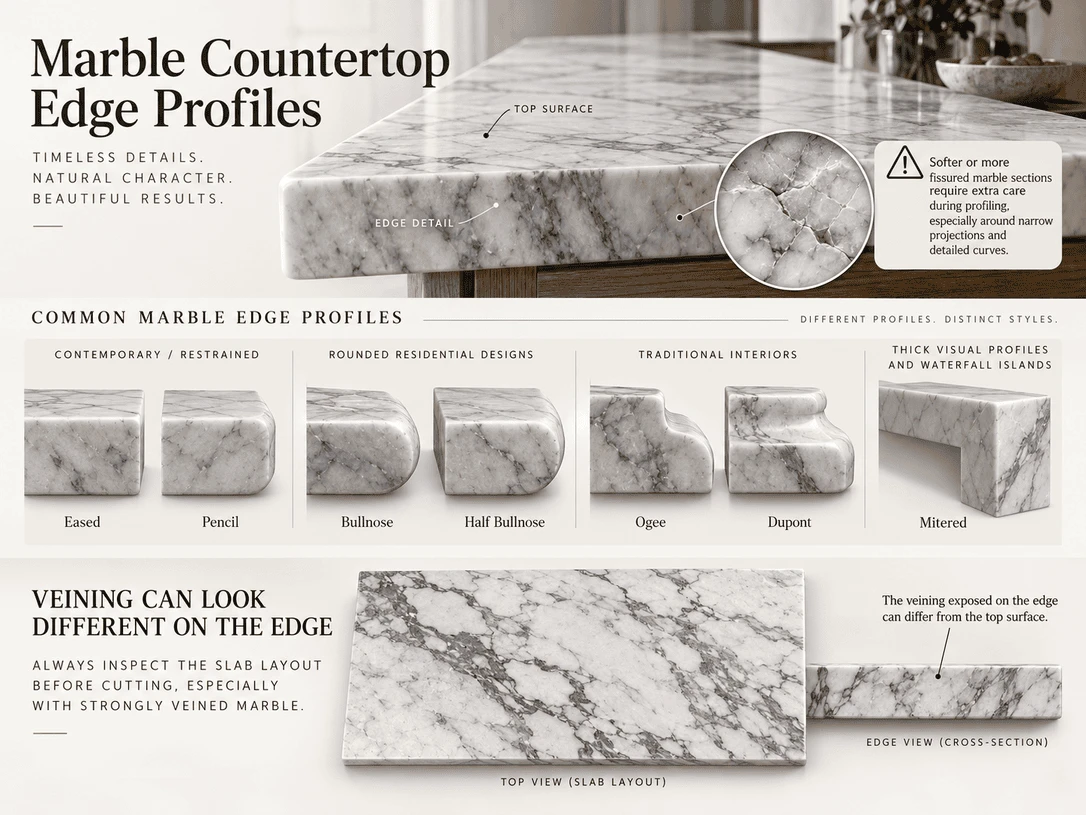
Marble is commonly selected for its veining and color variation. Softer or more fissured sections may require additional care during profiling, particularly around narrow projections and detailed curves.
Common choices include:
- Eased and pencil edges for restrained contemporary countertops
- Bullnose and half bullnose for rounded residential designs
- Ogee and Dupont for traditional interiors
- Mitered edges for thick visual profiles and waterfall islands
For strongly veined marble, inspect the slab layout before deciding where the edge will be cut. The edge may expose a different part of the stone's pattern from the top surface.
5.2 Granite Countertop Edge Profiles
Granite covers a wide range of mineral compositions and grain structures. Its fabrication response varies by material, so the same edge profile may require different tooling parameters across different granite types.
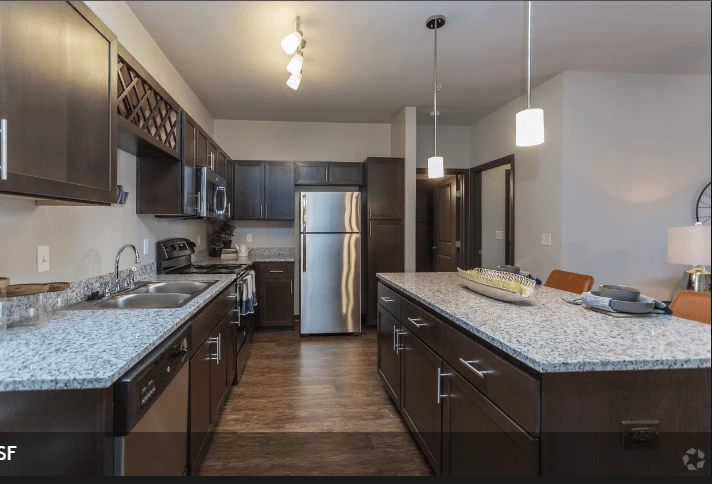
Straight, eased, bevelled, bullnose and ogee profiles are all used for granite countertops. The selected profile should be checked against the actual slab condition, particularly where the exposed edge crosses mineral clusters, fissures or repaired areas.
5.3 Quartzite Countertop Edge Profiles
Quartzite is often selected for its hardness and visual similarity to marble. True quartzite can be demanding to process because of its high silica content and abrasive mineral structure.
For quartzite countertops, confirm that the fabricator has suitable profiling tools and polishing procedures. Complex edges may involve more processing time than simple eased or straight profiles.
Do not assume every stone sold under a quartzite trade name has the same mineral composition or fabrication behavior. Material identification and sample inspection remain necessary.
5.4 Material and Profile Selection Table
| Stone Material | Common Edge Choices | Main Fabrication Consideration | Procurement Check |
|---|---|---|---|
| Marble | Eased, Pencil, Bullnose, Ogee, Mitered | Vein placement, fissures, edge finishing | Review slab condition and approved layout |
| Granite | Straight, Eased, Beveled, Bullnose, Ogee | Grain structure, mineral distribution, tooling | Inspect exposed edges and repaired areas |
| Quartzite | Eased, Straight, Beveled, Bullnose, Mitered | Abrasive hardness, tool wear, polishing | Confirm material identity and fabrication capability |
| Engineered Quartz | Eased, Straight, Beveled, Mitered | Product-specific fabrication instructions | Follow the manufacturer's processing requirements |
6. CNC Precision Cutting and Quality Control for Custom Stone Edges
Custom countertop edge fabrication should begin with an approved drawing or profile sample. CNC equipment can support repeatable dimensions and shaped components, but the finished result also depends on tooling condition, machine setup, operator control and final polishing.
6.1 Information Required Before Fabrication
A complete countertop edge specification should include:
| Drawing or Order Detail | Required Information |
|---|---|
| Stone material | Material name and approved slab or batch |
| Nominal thickness | 20 mm, 30 mm or specified alternative |
| Finished dimensions | Length, width and relevant cut-out positions |
| Edge profile | Profile name and cross-section drawing |
| Profile dimensions | Radius, bevel width, projection or overall depth |
| Exposed edges | Identify each finished side |
| Corners | Square, rounded, mitred or other specified treatment |
| Surface finish | Polished, honed or leathered, as applicable |
| Seam and joint details | Position, construction and visual requirements |
| Inspection criteria | Agreed dimensional and visual acceptance requirements |
6.2 CNC Profiling and Manual Finishing
CNC precision cutting can produce repeatable profile geometry and support complex countertop layouts. However, machine processing does not remove the need for final inspection.
A practical workflow includes:
- Review the approved shop drawing and slab condition.
- Mark the exposed edges and confirm the required profile.
- Cut the countertop components to the specified dimensions.
- Shape the edge using suitable profiling tools.
- Grind and polish the exposed profile to the approved finish.
- Inspect dimensions, corners, surface transitions and visible defects.
- Record production details where required by the project.
For ogee, Dupont and other multi-stage profiles, check the full edge length rather than inspecting only one sample point. Changes in curve depth or polishing quality can be more visible on long exposed runs.
6.3 Edge Inspection Before Packing
Before export packing, inspect the following:
- Profile geometry against the approved drawing or sample
- Consistency of the edge finish along the full exposed length
- Chips, cracks and visible damage
- Corner transitions and cut-out edges
- Bonded joints on laminated or mitered edges
- Vein direction and visual alignment where specified
- Protection of exposed edges during packing
For project orders, Guanmay can coordinate CAD and shop drawings, CNC precision fabrication, custom edge processing, production photos and videos, and project-specific export packaging. Edge requirements should be confirmed before cutting so the finished pieces can be checked against the approved details.
7. Best-Value Stone Edge Profiles for Wholesale and Large Projects
For apartment developments, hotel projects and repeated countertop orders, the most cost-effective edge is usually the one that meets the design specification with the fewest additional fabrication operations.
7.1 Recommended Profiles by Project Type
| Project Type | Recommended Edge | Reason |
|---|---|---|
| Standard apartment kitchens | Eased | Simple geometry and repeatable processing |
| Hotel guestroom vanity tops | Eased or Pencil | Restrained appearance and consistent production |
| Large residential developments | Eased or Straight | Easier to standardize across units |
| Traditional luxury kitchens | Bullnose or Ogee | Coordinates with decorative cabinetry |
| Contemporary kitchen islands | Eased or Mitered | Supports minimal or thick-profile designs |
| Commercial counters | Eased or Beveled | Simple exposed-edge geometry |
| Feature marble islands | Mitered or selected Ogee | Supports a specific architectural detail |
7.2 Why Eased Edges Are Often the Most Cost-Effective Choice
An eased edge is a practical default for large countertop programs because it generally requires fewer shaping operations than decorative profiles. Its simple cross-section also makes it easier to specify, inspect and reproduce across multiple units.
For procurement teams, standardizing an eased edge can reduce variation in:
- Profile dimensions
- Machine setup
- Polishing requirements
- Corner treatment
- Production inspection
- Replacement-piece specifications
This does not mean eased edges are always the correct choice. If the design requires a rounded perimeter, decorative moulding or a thick visual edge, the profile should be selected according to the approved interior design and construction detail.
7.3 Wholesale RFQ Checklist for a Countertop Edge Manufacturer
To obtain a comparable quotation from a stone edge manufacturer, provide the same technical information to each supplier.
| RFQ Item | Information to Provide |
|---|---|
| Material | Marble, granite, quartzite or engineered quartz |
| Quantity | Number of countertops or total component count |
| Dimensions | Finished length, width and thickness |
| Edge profile | Eased, bullnose, ogee, mitered or other |
| Profile drawing | Cross-section with dimensions |
| Edge length | Total exposed linear measurement |
| Finish | Polished, honed or leathered |
| Corner details | External and internal corner requirements |
| Cut-outs | Sink and other specified openings |
| Pattern requirements | Vein direction, book matching or slab allocation |
| Quality requirements | Dimensional and visual acceptance criteria |
| Packing | Edge protection and export packaging requirements |
Xiamen Guanmay Stone Co., Ltd. supplies natural stone slabs and fabricated countertop components for wholesale and project orders. Its production coordination can include material selection, CAD drawings, CNC processing, custom edge profiles, dry-lay review and export packaging.
For a multi-unit project, submit the countertop schedule and edge cross-section together. This allows the supplier to assess material use, exposed edge length, processing operations and production consistency before issuing a quotation.
Need repeatable edge profiles and fabrication pricing for a multi-unit project?
Get a Factory Direct Fabrication Quote
FAQ
Which countertop edge profile is the most cost-effective for large apartment projects?
An eased edge is often the most cost-effective option because its geometry is simple and repeatable. Confirm the profile dimensions and exposed edge lengths in the project drawings before quotation.
Does a bullnose edge require more fabrication than an eased edge?
Yes. A bullnose edge requires curved shaping and polishing, while an eased edge generally needs only a small corner transition and edge finishing. Actual cost depends on stone type, radius and total edge length.
Is a mitered edge stronger than an eased edge?
Not inherently. A mitered edge introduces a bonded joint, while an eased edge finishes the original slab edge. Structural performance depends on stone condition, joint design, adhesive, reinforcement where required and countertop support.