


Bookmatched marble is most effective for feature walls when the slabs are selected as a matched sequence rather than purchased as individual pieces. The key procurement controls are slab continuity, vein direction, block consistency, calibrated thickness, surface finish, and factory dry-lay before cutting. For luxury stone feature walls, marble and onyx are the primary materials for strong bookmatching effects, while the final result depends more on block selection and layout control than on the marble name alone.
Which Marble Is Best for Bookmatching?
Not every marble produces a useful bookmatched pattern. The best candidates have continuous veins, directional mineral structures, or strong tonal movement that becomes symmetrical when adjacent slabs are mirrored.
For residential villas, luxury hotels, private clubs, lobby walls, and high-end apartment interiors, the following stone characteristics are generally suitable:
| Stone characteristic | Bookmatch suitability | Typical visual result | Main procurement concern |
|---|---|---|---|
| Strong directional veining | Excellent | Clear mirrored pattern | Vein continuity between slabs |
| Cloud-like movement | Very good | Large symmetrical composition | Color variation |
| Linear veins | Excellent | Graphic geometric effect | Slab orientation |
| Fine uniform grain | Limited | Subtle symmetry | Low visual contrast |
| Highly fractured structure | Risky | Irregular pattern | Fabrication and breakage |
| Translucent structure | Excellent for feature walls | Veins with backlit effect | Thickness and light transmission |
| Strong color variation | Very good | High visual impact | Block-to-block consistency |
Marble such as Calacatta, Arabescato, Panda White, and selected Breccia varieties can create strong bookmatched compositions. However, the commercial suitability of a specific material should be judged from the actual block and slab sequence, not from catalogue photographs.
For translucent feature surfaces, onyx can provide another option because the mirrored pattern can be combined with a Backlit effect. This requires additional control of slab thickness, translucency, backing construction, LED distribution, and joint treatment.
How Does the Bookmatching Process Work?
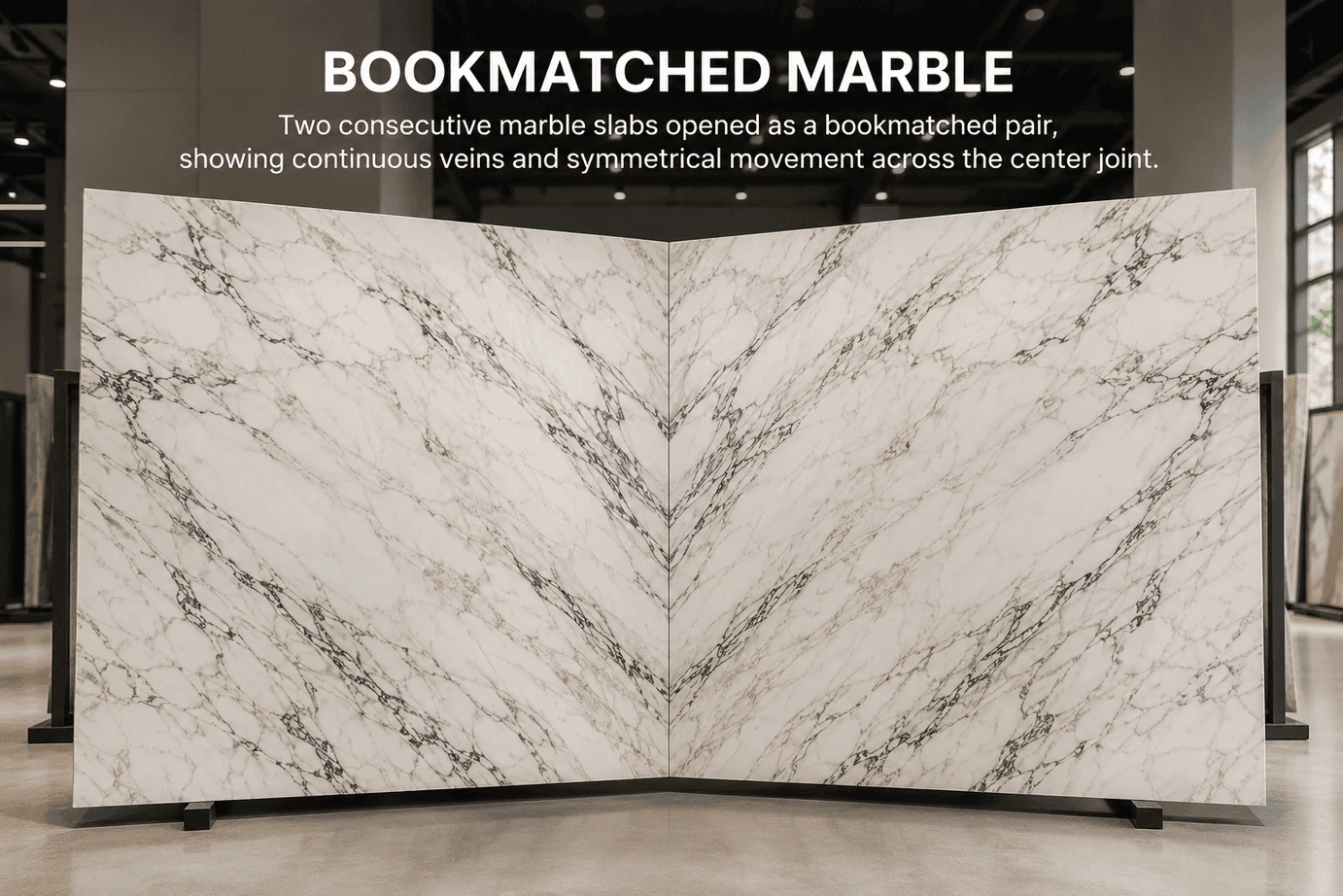
Bookmatching is created by taking sequential slabs from a block and opening them like pages of a book. The polished or finished faces form a mirrored image across the joint.
The basic sequence is: Block selection → Slab cutting → Slab numbering → Vein inspection → Bookmatch pairing → Dry-lay → CAD layout → CNC cutting → Edge and joint processing → Final QC → Packing
The most important point is that bookmatching begins before fabrication. If the slabs are cut without preserving their original sequence, the fabricator may have enough square meters but still lack the correct visual continuity.
1. Block selection
The block should first be evaluated for:
- Vein direction
- Vein density
- Background color
- Mineral concentration
- Natural fissures
- Resin-treated areas
- Thickness stability
- Expected slab yield
A block with strong directional veins is normally more suitable than a block with random granular movement.
For large feature walls, purchasing several unrelated slabs from different blocks creates a higher risk of color and pattern discontinuity.
2. Slab numbering
Each slab should receive a permanent identification number immediately after production.
A practical numbering system records:
| Control item | Purpose |
|---|---|
| Block number | Identifies the original stone block |
| Slab number | Preserves cutting sequence |
| Thickness | Confirms fabrication compatibility |
| Finish | Prevents finish mismatch |
| Surface orientation | Establishes installation direction |
| Bookmatch pair | Identifies adjacent slabs |
| Project zone | Links the slab to the elevation |
| QC status | Confirms acceptance before fabrication |
This information should remain connected to the slab through cutting, inspection, packing, and installation.
3. Vein direction
The direction of the marble pattern determines whether the final wall reads as symmetrical.
For example, a slab may be installed vertically even though its dominant vein runs horizontally. Rotating individual pieces without considering the original sequence can destroy the intended bookmatch.
This is particularly important for large hotel lobbies and villa feature walls where several slabs may form one continuous composition.
4. Dry-lay before cutting
A professional Dry-lay service is one of the most important controls for bookmatched projects.
The slabs are positioned in their intended sequence on a suitable flat surface before CNC cutting. The team checks:
- Vein continuity
- Color transition
- Slab orientation
- Joint location
- Fissures
- Cut-out positions
- Panel dimensions
- Bookmatch symmetry
The dry-lay should correspond to the architectural elevation or CAD drawing rather than being treated as a simple visual display.
Need to verify vein continuity before committing slabs to CNC cutting?
Request a Bookmatched Marble Dry-Lay Layout
What Should Buyers Check Before Ordering Bookmatched Marble?
The main procurement mistake is evaluating bookmatched marble by square-meter quantity alone. A feature wall is purchased as a visual sequence, so the usable quantity is determined by the complete composition.
A project may require eight slabs, but those eight slabs are not interchangeable. Slab order, orientation, color, vein direction, and usable cutting area all affect the final elevation.
Slab size and wall dimensions
Before ordering, compare the architectural elevation with the actual slab dimensions.
For example, a large lobby wall may require:
- Full-height slabs
- Multiple vertical panels
- Horizontal bookmatch
- Central symmetrical composition
- Door or niche cut-outs
- Electrical openings
- Lighting channels
The slab layout should therefore be developed before final cutting.
Calibrated thickness
Bookmatched panels installed on the same wall should have controlled thickness variation.
For stone panels, the project specification should define the nominal thickness and permitted tolerance. A value such as ±0.5 mm should not be presented as a universal marble tolerance; it must be confirmed against the actual fabrication specification and equipment capability.
Thickness consistency affects:
- Adhesive coverage
- Mechanical fixing
- Panel alignment
- Joint depth
- Edge transitions
- Shadow gaps
For large-format wall systems, the stone thickness also needs to be coordinated with the support or fixing system.
Surface finish
The same marble can produce very different visual results depending on the finish.
| Finish | Effect on bookmatching | Typical application |
|---|---|---|
| Polished | Maximum color and vein contrast | Luxury lobbies, feature walls |
| Honed | Lower reflection, softer pattern | Residential interiors, hotel rooms |
| Leathered | Textured surface with lower reflectivity | Selected architectural applications |
| Brushed | Enhanced tactile texture | Decorative interiors |
| Backlit | Reveals translucent structure | Onyx and selected translucent stone |
Polished marble is often preferred when the objective is to make the mirrored vein structure visually dominant. Honed finishes can be more suitable where reflections from lighting or large glazing surfaces need to be reduced.
Water absorption and staining
Water absorption is a material property, not a guarantee of stain resistance.
For natural marble, buyers should request the actual material technical data where available. Typical natural-stone performance varies significantly by variety and batch, so generic statements such as "marble absorbs less than 0.2%" should not be applied to all marble.
For interior feature walls, staining risk is usually lower than on kitchen countertops, but porous stones still require appropriate surface treatment and cleaning procedures.
How Does ASTM Testing Affect Marble Feature Wall Procurement?
ASTM test data can help buyers compare stone performance, but the correct test depends on the intended application.
Common natural-stone evaluations may include:
| Property | Why it matters | Typical reference |
|---|---|---|
| Water absorption | Indicates susceptibility to moisture penetration | ASTM C97/C97M |
| Density / specific gravity | Helps characterize stone mass | ASTM C97/C97M |
| Flexural strength | Relevant to panel handling and structural design | ASTM C880/C880M |
| Compressive strength | Useful for material characterization | ASTM C170/C170M |
| Abrasion resistance | More relevant to flooring than vertical walls | ASTM C1353 / project specification |
| Freeze-thaw resistance | Relevant for exterior climates | ASTM C666 or applicable project standard |
These standards should not be treated as a universal pass/fail checklist for every feature wall.
For an interior vertical application, flexural strength, dimensional stability, fixing method, panel size, support spacing, and handling requirements can be more relevant than floor abrasion performance.
The correct procurement document should therefore combine stone test data + panel dimensions + fixing method + installation conditions.
Have the marble selected but not yet matched to the architectural elevation?
Send Your Feature Wall Drawings for Stone Layout Review
How Do Factories Control Bookmatched Marble During CNC Fabrication?
The fabrication stage should preserve the approved dry-lay sequence.
After the project layout is confirmed, each slab is assigned to a specific panel position. The cutting program should reference the slab identification rather than only the finished panel dimensions.
CNC precision cutting
CNC equipment is useful for:
- Accurate panel sizing
- Repeated dimensions
- Door and niche openings
- Electrical openings
- Radius cutting
- Sink or fixture cut-outs
- Edge profiles
- Complex geometric details
However, CNC accuracy does not correct poor slab selection. A perfectly cut slab can still produce a poor feature wall if the vein sequence was wrong.
The fabrication workflow should therefore follow:
Approved dry-lay → Approved CAD elevation → Slab identification → CNC cutting → Edge processing → Surface inspection → Final dry inspection
Edge profiles and joints
Bookmatched walls usually depend on narrow and visually controlled joints.
The edge treatment should be selected according to the architectural detail:
- Square edge
- Micro-bevel
- Shadow gap
- Mitered return
- Bullnose
- Custom architectural profile
Mitered edges require additional stone thickness and fabrication control because the finished appearance depends on accurate angle cutting and joint alignment.
For large wall panels, the joint is not merely a finishing detail. It determines whether the mirrored pattern appears continuous from one panel to the next.
How Can Bookmatched Marble Increase the Visual Impact of a Luxury Interior?
The strongest bookmatched installations normally have a clear visual center rather than random panel placement.
Three layout strategies are commonly effective.
Central-axis bookmatching
Two slabs mirror across a central vertical joint.
This works well behind:
- Reception desks
- Hotel lobby walls
- Fireplace surrounds
- Master bedroom walls
- Luxury bathroom vanities
- Entry feature walls
Multi-slab continuous composition
Four, six, or more slabs are arranged to create a larger symmetrical composition.
This requires more careful block selection because color and vein movement must remain consistent across the entire elevation.
Bookmatched marble with architectural lighting
Lighting should be considered before fabrication.
Wall washers, concealed LED strips, niches, and backlighting can change how the marble pattern is perceived.
For translucent onyx, the light source needs to be distributed evenly behind the stone. Localized LED hotspots can make the surface appear visually inconsistent even when the slabs are correctly matched.

What Should a B2B Buyer Include in a Bookmatched Marble RFQ?
A technically complete RFQ reduces the risk of receiving visually incompatible slabs.
Instead of requesting only "bookmatched marble," provide the following information:
| RFQ requirement | Example specification |
|---|---|
| Stone type | Selected marble variety |
| Application | Interior feature wall |
| Slab dimensions | Required minimum dimensions |
| Thickness | Nominal project thickness |
| Finish | Polished / Honed / other |
| Bookmatch | 2-slab or multi-slab |
| Vein direction | Vertical / horizontal |
| Layout | Elevation drawing required |
| Cut-outs | Doors, niches, sockets, fixtures |
| Edge profile | Square / miter / custom |
| Surface treatment | Sealer or specified treatment |
| QC | Slab inspection + dry-lay approval |
| Packaging | Reinforced export packaging |
| Documentation | Stone technical data and QC records |
For large projects, the RFQ should also identify the required quantity of complete bookmatched sets rather than only total square meters.
For example, "12 m² marble" and "three approved four-slab bookmatched sets totaling 12 m²" are not equivalent purchasing specifications.
The second description defines the visual requirement and substantially reduces procurement ambiguity.
How Does Guanmay Handle Bookmatched Marble Fabrication?
For projects requiring bookmatched marble walls, the production workflow should connect stone selection, layout, fabrication, and QC rather than treating them as separate operations.
A project can be managed through:
Slab selection → Slab numbering → CAD elevation → Bookmatch dry-lay → CNC precision cutting → Edge fabrication → Surface inspection → Final QC → Export-grade packaging
CAD and shop drawings can be used to map individual slabs to their installation positions. Dry-lay inspection allows the buyer or project team to review the actual stone sequence before final fabrication.
For complex feature walls, this process is particularly useful when the project contains multiple elevations, openings, niches, curved details, or mitered returns.

Bookmatched Marble Procurement Checklist
Before approving production, confirm these points:
- Actual slab photographs have been reviewed.
- Slabs come from a compatible block or approved sequence.
- Each slab has a traceable identification number.
- Vein direction has been confirmed.
- Bookmatch pairs have been identified.
- Slab dimensions match the architectural elevation.
- Nominal thickness and tolerance are specified.
- Surface finish has been approved.
- Natural fissures and repaired areas have been reviewed.
- Dry-lay has been completed where required.
- CAD panel positions correspond to slab numbers.
- CNC cut-outs have been checked against drawings.
- Edge profiles and joint details are confirmed.
- Packaging protects finished surfaces and panel edges.
For large commercial projects, the most important document is often not a generic stone catalogue. It is the combination of actual slab images, numbered layout drawings, approved dry-lay records, fabrication drawings, and QC documentation.
FAQ
How early should bookmatched marble be selected for a feature wall?
Bookmatched marble should be selected before final fabrication drawings are released. The slab sequence affects panel dimensions, joint positions, cut-outs, and the overall elevation, so late material selection can force changes to the fabrication layout.
Can any marble be used for bookmatching?
No. Bookmatching works best with marble that has directional veins or strong mineral movement. Fine-grained and visually uniform marble may produce little visible symmetry. The actual slab sequence should be reviewed before purchase.
Is dry-lay necessary for large bookmatched marble projects?
Yes, for visually demanding projects it is strongly recommended. Dry-lay verifies vein continuity, color transitions, slab orientation, cut-out positions, and panel sequencing before CNC fabrication and installation.
